En español: Inútil hasta que dejó de serlo.
Funding decisions often split science into two piles. One is called useful or applied, the kind with a clear product at the end. The other is called basic or curiosity-driven, and it is the first to be cut when budgets tighten, on the assumption that it is a luxury. The history of technology does not support that split. A large share of the tools that now run medicine, communications, and the economy came out of work that had no application in view at the time, and that some of its own funders considered pointless.
Below are twelve cases. They are not folklore. Each claim links to its source: an original paper indexed in PubMed, a Nobel record, a regulatory approval, or a primary historical account. Where a popular version of a story is exaggerated, the exaggeration is flagged.
One thing to watch as you read is the gap between the question and the payoff. This chart shows it for all twelve, sorted by how long it took for each discovery to reach the public.
CRISPR gene editing, from salt-marsh microbes
In the early 1990s Francisco Mojica, at the University of Alicante, studied a salt-tolerant microbe, Haloferax mediterranei, taken from the salterns near Santa Pola in southeastern Spain. He wanted to understand how it copes with extreme salinity. In its genome he found short DNA sequences repeated at regular intervals, separated by unique spacers. He had no idea what they did. He later coined the name CRISPR for them.
In 2003 he noticed that the spacer sequences matched the DNA of viruses, and that microbes carrying a given spacer resisted the matching virus. He proposed that CRISPR is an immune system that stores a memory of past infections. Several journals turned the paper down, including one that rejected it without review, before it appeared in 2005.1 That insight set up the 2012 work of Charpentier and Doudna, who showed the Cas9 enzyme could be programmed to cut DNA at a chosen site.2 They received the 2020 Nobel Prize in Chemistry.3 In December 2023 the first CRISPR therapy, for sickle cell disease, was approved by the United States Food and Drug Administration.4 Mojica, who started it by asking why a pond microbe had repetitive DNA, was not among the laureates.
The GLP-1 drugs, from gut hormones and lizard venom
The drugs now sold as Ozempic and Wegovy come from two separate lines of curiosity-driven work. In the 1980s, endocrinology labs were taking apart the proglucagon gene to understand how the body controls insulin. Svetlana Mojsov, working with Joel Habener, identified the active form of a gut hormone, GLP-1, and showed in 1987 that it is a strong trigger for insulin release.5 No weight-loss program was involved. Her role was underacknowledged for decades and has only recently been recognized.
The second line began with John Eng at a Veterans Affairs laboratory in the Bronx, who was curious about why a venomous desert lizard, the Gila monster, can fast for long periods without its blood sugar collapsing. In 1992 he isolated a peptide from its venom, exendin-4, that resembles human GLP-1 but lasts much longer in the body.6 A synthetic version, exenatide, became the first drug of this class, approved in 2005. Longer-acting analogs followed, and in a 2023 trial of more than 17,000 people, semaglutide cut major cardiovascular events by about a fifth.7 One caution on the popular telling: semaglutide is a human hormone analog, not a venom product. The lizard venom led to the earlier drug, exenatide.
Restriction enzymes, from a question about viruses
In the early 1950s researchers noticed that a virus able to grow on one strain of bacteria was often blocked, or restricted, when it tried to infect another. Starting around 1960, Werner Arber set out to explain why. By 1962 he and Daisy Dussoix had shown the effect works on the virus’s DNA: bacteria chemically mark their own DNA and cut up foreign DNA that lacks the mark.8
This was bacterial genetics with no product in sight. The 1962 papers are titled simply “Host specificity of DNA produced by Escherichia coli.” But Arber’s predicted cutting enzyme, isolated by Hamilton Smith in 19709 and put to use by Daniel Nathans in 1971,10 turned out to cut DNA at specific, predictable sequences. That made it possible to cut and paste DNA reliably. Recombinant DNA followed in 1973, and with it the biotechnology industry. The first product was human insulin made in bacteria, approved in 1982. Arber, Smith, and Nathans shared the 1978 Nobel Prize in Physiology or Medicine.11
PCR, from microbes in a hot spring
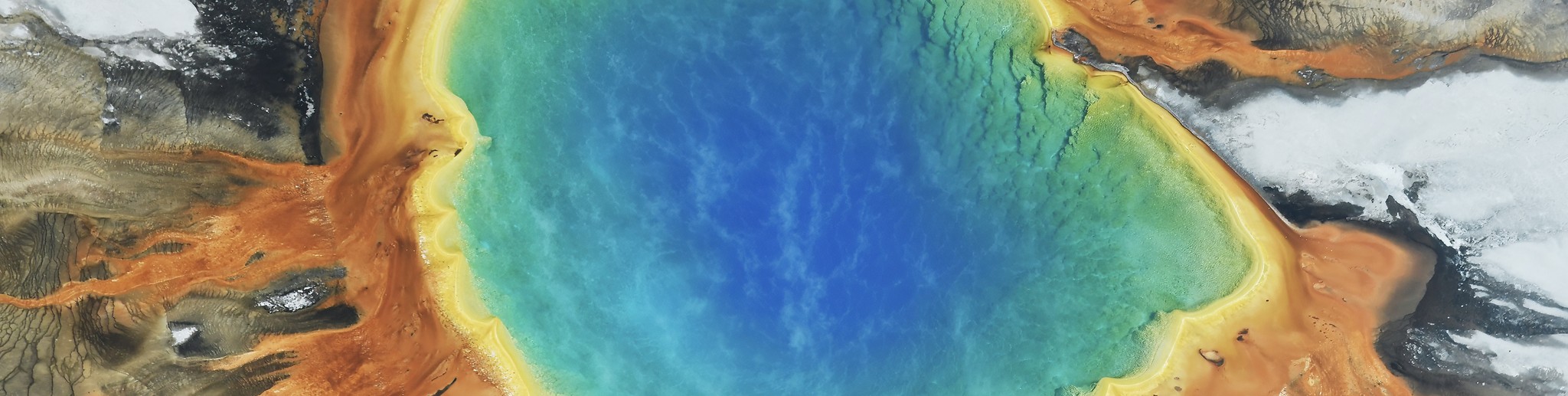
In the late 1960s Thomas Brock and his student Hudson Freeze were studying whether anything could live in the near-boiling springs of Yellowstone. The question was basic biology: how hot is too hot for life? From a spring at about 70 degrees Celsius they isolated a new bacterium, Thermus aquaticus, and deposited it in a public culture collection so others could use it.12
Two decades later, the polymerase chain reaction, conceived by Kary Mullis in 1983, needed an enzyme that could survive the repeated heating used to separate DNA strands. The heat-stable enzyme from Brock’s hot-spring bacterium, called Taq, was the answer, used to automate PCR in 1988.13 PCR is now everywhere: forensics, genome sequencing, and the diagnostic tests used for COVID-19. Brock made the point himself in the title of a 1997 article: “The value of basic research: discovery of Thermus aquaticus and other extreme thermophiles.”14 Note the order of events: PCR was invented first, and the hot-spring enzyme is what made it practical.
Green fluorescent protein, from a glowing jellyfish
Osamu Shimomura wanted to know why the jellyfish Aequorea victoria glows. Starting in 1961 he collected very large numbers of them, somewhere between several hundred thousand and roughly a million over the years, to extract the proteins responsible. Alongside the protein he was after, he isolated a second one that glowed green, now called green fluorescent protein.15
For thirty years it was a curiosity. Then, in the 1990s, the gene was cloned and shown to glow when expressed in other organisms, with no special chemicals added.16 That made it a genetic label: attach it to a protein and you can watch that protein inside a living cell. It is now one of the standard tools of biology, used to track tumors, light up neurons, and follow proteins as they move. Shimomura, Martin Chalfie, and Roger Tsien shared the 2008 Nobel Prize in Chemistry.17 Douglas Prasher, who first cloned the gene and gave his copy to the others, had by then run out of funding and left research.
mRNA vaccines, from work nobody would fund
Katalin Karikó spent the 1990s at the University of Pennsylvania on a question most of her field had written off: whether synthetic messenger RNA could be put into cells to make a chosen protein. The body reacted to lab-made RNA with inflammation, and the idea was considered a dead end. Her grant applications were rejected repeatedly, and in 1995 the university demoted her.
Working with the immunologist Drew Weissman, she pursued why the RNA caused inflammation. In 2005 they reported the answer: a small chemical change to the RNA’s building blocks makes the immune system ignore it.18 The paper was turned down by two major journals before it was published. Fifteen years later, that same chemical change is in the Pfizer-BioNTech and Moderna COVID-19 vaccines, given billions of times. Karikó and Weissman received the 2023 Nobel Prize in Physiology or Medicine.19 The prize was specifically for the chemistry of the RNA, not for inventing the vaccine, which also required other groups’ work on delivery and on the spike protein.
Monoclonal antibodies, from a question about the immune system
In 1975 César Milstein and Georges Köhler, at the Medical Research Council laboratory in Cambridge, were trying to understand how the immune system generates its enormous variety of antibodies. To study that, they fused antibody-making cells with cells that divide forever, producing a line that makes one defined antibody without end.20 The technique, called the hybridoma, was a tool to answer a basic question.
The original paper’s only nod to use was a single closing sentence: such cultures could be valuable for medical and industrial use. That turned out to be the foundation of an industry. The first therapeutic monoclonal antibody was approved in 1986, and they are now a leading class of medicines, including treatments for cancer and autoimmune disease, as well as the active part of home pregnancy tests and rapid antigen tests. Milstein and Köhler received the 1984 Nobel Prize.21 The technique was never patented. The common version says they refused on principle, but the record is more mundane: it was published before any filing, and the body responsible saw nothing obviously patentable in it.
Telomerase, from pond scum
Elizabeth Blackburn studied a freshwater single-celled organism, Tetrahymena, which she has called pond scum. She chose it for a practical reason: it carries an unusually large number of chromosome ends, which is what she wanted to understand. In 1978 she found that those ends are made of a short sequence repeated over and over.22
With her student Carol Greider, she went looking for the enzyme that builds those repeats. On Christmas Day 1984, Greider saw the first sign of it on a gel.23 The enzyme, telomerase, turned out to matter far beyond pond organisms. Most human cancers switch it back on to keep dividing, which makes it a drug target, and the gradual shortening of chromosome ends is central to research on aging. Blackburn, Greider, and Jack Szostak shared the 2009 Nobel Prize in Physiology or Medicine.24 In 2024 a telomerase inhibitor was approved for a form of blood cancer.25 One caution: longer telomeres are not simply good, since the same enzyme that maintains them also helps cancers grow, and no anti-aging treatment follows directly from this.
The laser, from a 1917 thought experiment
In 1917 Albert Einstein worked out a piece of theory about how light and matter exchange energy.26 To make the numbers add up, he argued there must be a process he called stimulated emission, in which one particle of light triggers an atom to release a second, identical one. There was no device in mind and no mention of any application. The idea sat mostly unused for decades.
It became a microwave amplifier in the mid-1950s, and the first laser in 1960, built by Theodore Maiman from a ruby crystal. In its early days the laser was often described as a solution looking for a problem. It is now in fiber-optic cables that carry the internet, in eye surgery, in manufacturing, and in the scanner at every checkout. Two points worth keeping straight: Einstein supplied the physics but did not invent the laser, and Maiman, who built the first one, never received the Nobel Prize. The 1964 physics prize went to Charles Townes, Nikolay Basov, and Aleksandr Prokhorov for the underlying principle.27
GPS, from relativity
Einstein reworked our picture of space, time, and gravity in 1905 and 1915 out of pure curiosity about how the universe fits together. There was no satellite navigation, and no clocks precise enough for the effects to matter in daily life. His theories are now built into GPS.
A GPS receiver works by timing signals from satellites, so the satellites’ clocks have to be extremely accurate. Two effects from relativity act on those clocks. Their speed makes them run slightly slow, and the weaker gravity at their altitude makes them run faster, by a larger amount. The net result is that a satellite clock gains about 38 millionths of a second per day relative to the ground. Left uncorrected, that would push navigation off by roughly ten kilometers per day within a day. Engineers compensate for it by design, setting the clocks to tick at the wrong rate on the ground so that they tick correctly in orbit.28 The system only works because Einstein’s curiosity-driven theory is right.
X-rays, from tinkering with a tube
On an evening in November 1895, Wilhelm Röntgen was experimenting with a cathode-ray tube, a standard piece of physics apparatus, when he noticed a screen across the room glowing although nothing should have reached it. He had found a new kind of ray and called it X for unknown. He was not looking for a medical instrument.29
Within weeks his image of his wife’s hand, bones and ring visible, was reprinted around the world, and the medical use was obvious almost at once. X-rays are now the basis of radiography and of CT scanning, used hundreds of millions of times a year, and the same physics, applied to crystals, was later used to work out the structure of DNA. Röntgen received the first Nobel Prize in Physics, in 1901.30 He is widely reported to have declined to patent the discovery so it would be freely available, though that detail rests on secondary accounts rather than a primary record.
RSA encryption, from the most useless mathematics
In 1940 the mathematician G. H. Hardy wrote a short book defending pure mathematics, and number theory in particular, precisely because he believed it was useless. “No one has yet discovered any warlike purpose to be served by the theory of numbers,” he wrote, and he meant it as praise.31 Number theory, the study of whole numbers and primes, had been pursued for centuries with no practical aim.
In 1977 three researchers at MIT, Rivest, Shamir, and Adleman, built a method for sending secret messages that anyone could lock but only the intended reader could unlock.32 Its security rests directly on old number theory, including results from Fermat and Euler, and on the fact that multiplying two large primes is easy while undoing the multiplication is, in practice, infeasible. That method, RSA, and the public-key idea it helped launch, now protect online banking, commerce, and essentially every secure web connection. The branch of mathematics Hardy prized for being good for nothing turned out to secure the digital economy.
The pattern
The dates in these stories are worth noticing. Einstein’s stimulated emission preceded the laser by more than forty years, and GPS by almost a century. Number theory was old before it secured anything. Restriction enzymes, telomerase, and the glowing jellyfish protein each spent decades as pure biology before they became tools. In each case the application could not have been named in advance, because no one knew it was coming, including the people doing the work.
The same twelve discoveries can be read another way: by where the curiosity started and where it paid off. The next chart traces each one from its field of origin to its field of use.
The curiosity rarely paid off in the field where it began. Physics built the internet and the navigation in your phone. A pond organism, a marine one, and a soil bacterium ended up in hospitals. Pure number theory secured the digital economy. The field that funds a question is often not the field that collects the return.
This is why the split between applied and basic science is misleading. There is really one activity, the effort to understand how nature works, and the applications come out of it, often decades later. Treating the understanding as wasteful because it has no product yet mistakes the order in which the two appear.
There is also a cost here that does not appear on this year’s budget. Cutting curiosity-driven research now breaks nothing immediately. The bill arrives later, as an empty pipeline. The technologies of the 2050s depend on the fundamental questions being asked today, and a country that stops asking them will find, twenty or forty years on, that it has little of its own left to apply.
Why a small country needs basic science
It is tempting for a small country to treat basic research as a luxury for wealthy ones, and to conclude that the efficient path is to let larger countries do the fundamental work and apply the results at home. That reasoning has two holes.
The first is that no one else will study your own nature for you. Chile’s deserts, fjords, forests, soils, and coastal waters, and the organisms that live in them, are not on anyone else’s research agenda. Understanding them is the basis for managing fisheries, water, agriculture, conservation, and biosecurity, and that understanding has to be built locally, from fundamental work on local systems. It cannot be imported.
The second is that using a technology well still requires people who understand it at the level where it was made. A country that only adapts what others discover stays dependent on them, and it cannot answer the mechanistic questions whose answers become the technologies of the next generation. Building that capacity, the people, the training, and the questions, is itself the long-term investment. It is not a matter of copying foreign research and trying it at home. It is about understanding nature well enough to manage it, and asking the fundamental questions of today to support the technologies of tomorrow.
None of this means every basic project pays off, or that applied research does not matter. It means the line between useful and useless science is not visible at the start, that cutting the basic side drains a pipeline the country will need later, and that a small country, of all places, cannot afford to stop asking fundamental questions about its own world.
References
Mojica FJM, Díez-Villaseñor C, García-Martínez J, Soria E. “Intervening sequences of regularly spaced prokaryotic repeats derive from foreign genetic elements.” Journal of Molecular Evolution, 2005. PubMed 15791728. ↩︎
Jinek M, Chylinski K, Fonfara I, Hauer M, Doudna JA, Charpentier E. “A programmable dual-RNA-guided DNA endonuclease in adaptive bacterial immunity.” Science, 2012. PubMed 22745249. ↩︎
The Nobel Prize in Chemistry 2020 (Emmanuelle Charpentier and Jennifer A. Doudna). nobelprize.org. ↩︎
U.S. Food and Drug Administration, “FDA Approves First Gene Therapies to Treat Patients with Sickle Cell Disease,” December 2023. fda.gov. ↩︎
Mojsov S, Weir GC, Habener JF. “Insulinotropin: glucagon-like peptide I (7-37) co-encoded in the glucagon gene is a potent stimulator of insulin release in the perfused rat pancreas.” Journal of Clinical Investigation, 1987. PubMed 3543057. ↩︎
Eng J, Kleinman WA, Singh L, Singh G, Raufman JP. “Isolation and characterization of exendin-4, an exendin-3 analogue, from Heloderma suspectum venom.” Journal of Biological Chemistry, 1992. PubMed 1313797. ↩︎
Lincoff AM, Brown-Frandsen K, Colhoun HM, et al. “Semaglutide and Cardiovascular Outcomes in Obesity without Diabetes” (SELECT). New England Journal of Medicine, 2023. PubMed 37952131. ↩︎
Arber W, Dussoix D. “Host specificity of DNA produced by Escherichia coli. I.” Journal of Molecular Biology, 1962. PubMed 13862047. ↩︎
Smith HO, Wilcox KW. “A restriction enzyme from Hemophilus influenzae. I. Purification and general properties.” Journal of Molecular Biology, 1970. PubMed 5312500. ↩︎
Danna K, Nathans D. “Specific cleavage of simian virus 40 DNA by restriction endonuclease of Hemophilus influenzae.” PNAS, 1971. PubMed 4332003. ↩︎
The Nobel Prize in Physiology or Medicine 1978 (Arber, Nathans, Smith). nobelprize.org. ↩︎
Brock TD, Freeze H. “Thermus aquaticus gen. n. and sp. n., a nonsporulating extreme thermophile.” Journal of Bacteriology, 1969. PubMed 5781580. ↩︎
Saiki RK, Gelfand DH, Stoffel S, et al. “Primer-directed enzymatic amplification of DNA with a thermostable DNA polymerase.” Science, 1988. PubMed 2448875. ↩︎
Brock TD. “The value of basic research: discovery of Thermus aquaticus and other extreme thermophiles.” Genetics, 1997. PubMed 9258667. ↩︎
Shimomura O, Johnson FH, Saiga Y. “Extraction, purification and properties of aequorin, a bioluminescent protein from the luminous hydromedusan, Aequorea.” Journal of Cellular and Comparative Physiology, 1962. PubMed 13911999. ↩︎
Chalfie M, Tu Y, Euskirchen G, Ward WW, Prasher DC. “Green fluorescent protein as a marker for gene expression.” Science, 1994. PubMed 8303295. ↩︎
The Nobel Prize in Chemistry 2008 (Shimomura, Chalfie, Tsien). nobelprize.org. ↩︎
Karikó K, Buckstein M, Ni H, Weissman D. “Suppression of RNA recognition by Toll-like receptors: the impact of nucleoside modification and the evolutionary origin of RNA.” Immunity, 2005. PubMed 16111635. ↩︎
The Nobel Prize in Physiology or Medicine 2023 (Karikó and Weissman). nobelprize.org. ↩︎
Köhler G, Milstein C. “Continuous cultures of fused cells secreting antibody of predefined specificity.” Nature, 1975. PubMed 1172191. ↩︎
The Nobel Prize in Physiology or Medicine 1984 (Jerne, Köhler, Milstein). nobelprize.org. ↩︎
Blackburn EH, Gall JG. “A tandemly repeated sequence at the termini of the extrachromosomal ribosomal RNA genes in Tetrahymena.” Journal of Molecular Biology, 1978. PubMed 642006. ↩︎
Greider CW, Blackburn EH. “Identification of a specific telomere terminal transferase activity in Tetrahymena extracts.” Cell, 1985. PubMed 3907856. ↩︎
The Nobel Prize in Physiology or Medicine 2009 (Blackburn, Greider, Szostak). nobelprize.org. ↩︎
U.S. Food and Drug Administration, “FDA approves imetelstat for low- to intermediate-1 risk myelodysplastic syndromes with transfusion-dependent anemia,” June 2024. fda.gov. ↩︎
Einstein A. “Zur Quantentheorie der Strahlung” (On the Quantum Theory of Radiation). Physikalische Zeitschrift, 1917. ↩︎
The Nobel Prize in Physics 1964 (Townes, Basov, Prokhorov). nobelprize.org. ↩︎
Ashby N. “Relativity in the Global Positioning System.” Living Reviews in Relativity, 2003. doi.org/10.12942/lrr-2003-1. ↩︎
American Physical Society, “November 8, 1895: Roentgen’s Discovery of X-Rays,” 2001. aps.org. ↩︎
The Nobel Prize in Physics 1901 (Wilhelm Conrad Röntgen). nobelprize.org. ↩︎
Hardy GH. A Mathematician’s Apology, 1940. MacTutor, University of St Andrews. ↩︎
Rivest R, Shamir A, Adleman L. “A Method for Obtaining Digital Signatures and Public-Key Cryptosystems.” Communications of the ACM, 1978. doi.org/10.1145/359340.359342. ↩︎